What the Coronado Cays "Jet House" Teaches Buyers About HOA Protection
September 3, 2026
September 3, 2026
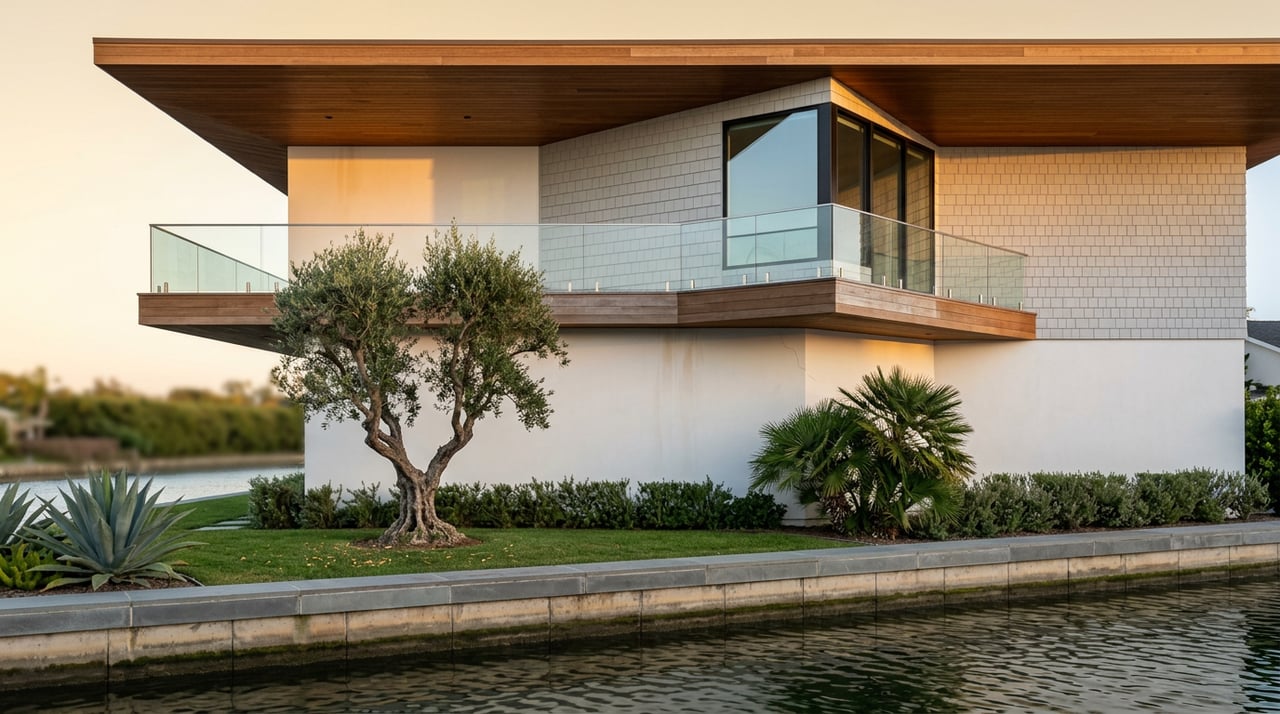
On the morning of July 22, 2026, a crane lowered a 40-foot, 14,000-pound Gulfstream G550 fuselage onto the roof of a house under construction at 15 Sandpiper Strand in Coronado Cays. Neighbors had been trying to stop this exact image since April, when a group led by Garrett and Amanda Pagon, who live directly across the street, filed suit in San Diego Superior Court against the property owner and the Coronado Cays Homeowners Association. The fuselage went up anyway. A hearing scheduled for mid-September will decide whether a judge can order it removed, and the outcome turns on a narrow, procedural question: whether the plans the HOA approved back in 2023 actually showed what got built.
If you're comparing Coronado's waterfront pockets this year, Village against Shores against Cays, this dispute might read as local color, the kind of story that makes good dinner conversation but doesn't change how you shop. I'd argue the opposite. This is the clearest public look anyone has gotten into how architectural review actually works inside the Cays, and it exposes a gap between what buyers assume an HOA protects them from and what it actually protects them from, and when.
The timeline matters more than the jet itself.
Notice how much of that timeline sits before the lawsuit even existed. The decision that shaped this stretch of canal was made in 2023. The public didn't find out anything was wrong with how it was made until two years later. That gap, not the jet, is the part every Cays buyer should sit with.
California law requires sellers in a common interest development to hand buyers a resale disclosure packet under Civil Code Section 4525 before they remove contingencies. The packet has to include the CC&Rs, the current budget, an insurance summary, any pending litigation involving the association, and, if requested, board meeting minutes covering the prior twelve months, excluding anything discussed in closed session.
Run that requirement against the Jet House timeline. Anyone who bought in Green Turtle Cay village in 2024, a year after the original approval and a year before the no-renderings issue became public, would have received a technically complete packet. Nothing in it would have flagged a problem, because nothing had been logged as a problem yet. There was no pending litigation to disclose. The minutes window wouldn't have reached back to the original 2023 vote unless a later meeting revisited it.
If you're shopping the Cays today, the packet you receive will disclose this specific case, because it's now active litigation and the law requires that disclosure. What it won't automatically catch is the next one: an approval sitting quietly in a three or four year old set of minutes, in a village you haven't asked about yet, that hasn't drawn a lawsuit and therefore hasn't tripped any disclosure requirement at all. Compliance and visibility are two different things, and the law only guarantees the first one.
Part of what makes this case harder to generalize from is that "the Coronado Cays HOA" isn't one governance regime. The community is built from ten distinct sub-villages, and the HOA's own defense in this lawsuit leans on that structure directly: it argues that Green Turtle Cay is specifically designated for custom-built homes, where owners have historically been allowed wide latitude, including domes, pergolas, putting greens, and custom art installations. A condominium village like Montego, by contrast, operates under a shared architectural palette because the units share buildings and sightlines by design.
That distinction is worth carrying into any tour. A design review committee's discretion in a custom lot village is not the same discretion it exercises in a standardized condo village next door. If you're evaluating a property in the Cays, the question isn't just "does this community have an HOA." It's "which village's design rules apply to this specific lot, and how wide is that particular committee's latitude." Ask for the design guidelines by village, not the community-wide summary.
Closed sales in Coronado Cays during the first quarter of 2026 averaged just under $2 million across nine transactions, with homes running roughly 2,100 square feet on average. Meanwhile, Coronado Village listings have been clustering above $3 million through the summer of 2026. That's a meaningful spread for two neighborhoods separated by a few miles of Silver Strand.
Some of that gap is straightforward: private dock access, a quieter canal setting, and distance from Orange Avenue's walkable core versus a historic village core built around a pedestrian commercial spine. But part of what that lower price point buys is a different governance bargain. The Village's smaller lots and closer spacing tend toward more visible, faster community pushback on anything out of character. The Cays' larger, more private custom lots come with committees built to accommodate exactly the kind of individuality that, in this case, turned into an airplane on a roof. Waterfront privacy and design latitude are often the same trade dressed differently. Buyers weighing the discount should weigh that trade explicitly, not assume it's free.
None of this means the Cays are a bad buy. It means the standard disclosure process protects you from what's already gone wrong, not from what's already been approved and just hasn't been built yet. A few things worth doing before you waive anything:
After twenty years of evaluating what a design review board will or won't allow on a given lot, this case is the one I'd point a Cays buyer to first. It's not a reason to avoid the neighborhood. It's a reason to ask better questions before you're the one standing across the canal from a project that got approved three years before you moved in.
If you're weighing Coronado Village against the Cays, or trying to figure out what a specific waterfront lot's design history actually allows, I'd rather walk you through it before you write an offer than after. Whiskey Kidd Realty can help you request the right documents, ask the right people the right questions, and read what's actually in an HOA's file before it becomes your problem.
Does this affect every village in Coronado Cays the same way? No. Green Turtle Cay is designated for custom-built homes with more design latitude, while other villages, particularly condominium communities like Montego, operate under a shared architectural standard with less room for individual variation. Ask which rules apply to the specific lot you're considering, not the community as a whole.
Is the fuselage definitely coming down? That hasn't been decided. A hearing scheduled for mid-September 2026 will determine whether the court can order its removal. As of this writing, the fuselage remains installed and the case is unresolved.
Stay up to date on the latest real estate trends.
Get assistance in determining current property value, crafting a competitive offer, writing and negotiating a contract, and much more. Contact Matt today to discuss all your real estate needs!