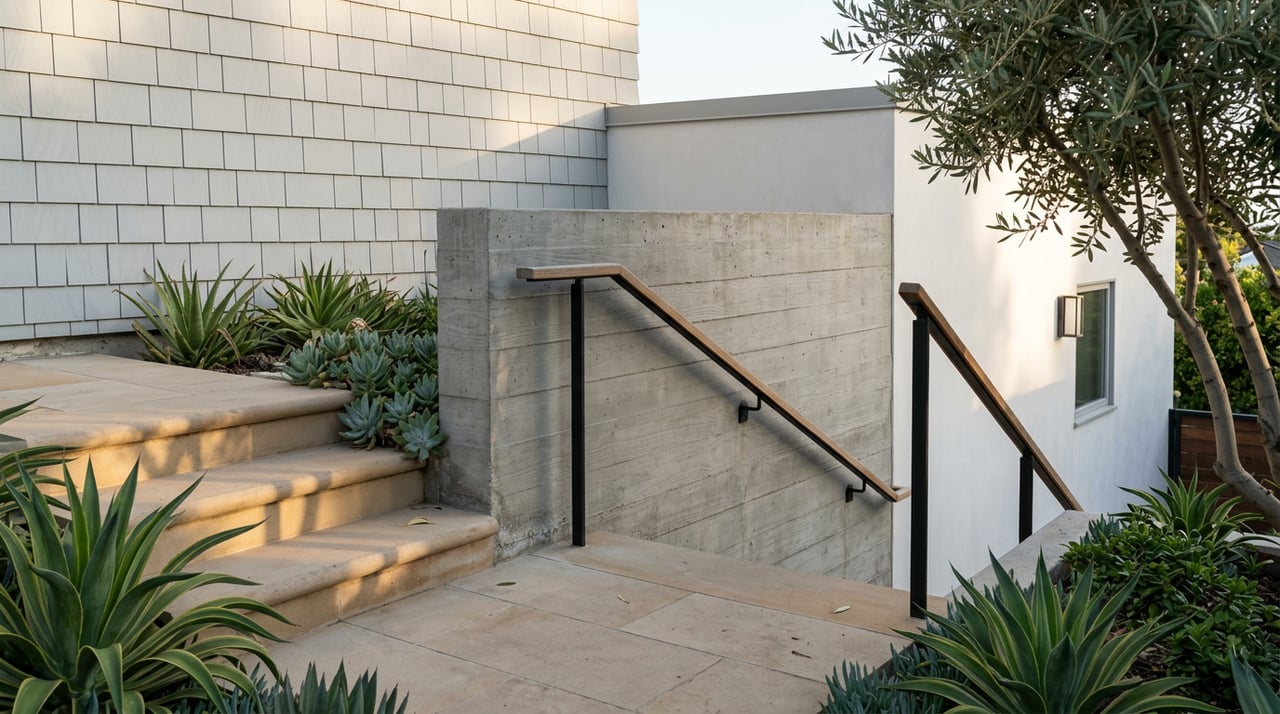
Same View, Different Rights: What Selling a Bluff-Top Home in Solana Beach Actually Requires
August 13, 2026
August 13, 2026
Walk the bluff top along Pacific Avenue in Solana Beach and you will notice something odd if you know where to look: a gap in an otherwise continuous run of seawall. It is not an oversight. In 1991, the owners of that one parcel accepted a trade with the California Coastal Commission. They could build a new home within 20 feet of the bluff edge, closer than the rules would normally allow, but only if they gave up their right to ever build a seawall to protect it. The Commission has held them to that bargain and denied armoring at that address five times since. When neighbors later tried to fill the gap themselves, without the original owner even joining the application, commissioners saw the maneuver for what it was and rejected it 7 to 5. One commissioner called the whole situation a poster child for managed retreat.
That gap is the whole story of bluff-top real estate in Solana Beach in miniature. From the street, from a listing photo, from a drone shot at golden hour, every home on that block looks like it has the same claim on the ocean. It does not. The rights attached to a bluff-top parcel here were often decided years or decades before the current owner ever saw the property, and those decisions travel with the deed, not with the view.
Sellers and buyers tend to treat "bluff-top" as a single tier of the market. It isn't. Solana Beach regulates new construction and substantial remodels against a Geologic Setback Line, a standard that factors in historic erosion rates, projected future erosion, and sea level rise. Homes built before that standard existed can legally sit closer to the bluff edge than anything built or substantially remodeled today would be permitted to. That is not a technicality. It means a 1970s home and a 2020s rebuild three doors apart can carry meaningfully different compliance profiles even when their views are indistinguishable.
The gap between those two eras is widening, not narrowing. As older cottages along the bluff get replaced with new construction, the new homes have to meet a stricter, more conservative setback than their predecessors ever did. So the market is quietly sorting itself into two populations: legacy structures grandfathered into a more permissive era, and new builds constrained by a rule written with sea level rise already priced in.
For a seller, this shows up as a documentation question. For a buyer, it shows up as a due diligence question. For both, it is the kind of detail that a comp sheet or a walkthrough will never surface on its own.
Solana Beach's bluffs are Torrey Sandstone, a soft sedimentary formation that erodes steadily rather than holding a fixed line. Buried within it is a "clean sand lens," a layer of loose, sandy material sandwiched between sheets of harder sandstone. When wave action or storm runoff exposes that lens, the sandstone above it can lose its footing, and that kind of failure is what typically forces the legal question of a seawall in the first place.
Erosion along San Diego County's coastal bluffs averages about six inches a year, though the number that matters more to an owner is the other one: episodic collapses can take several feet at once, all in a single storm event rather than spread evenly across a calendar. That unevenness is why a bluff-top home can look stable for a decade and then generate an urgent geotechnical referral the following winter.
Here is what tends to differ from one bluff-top parcel to the next, and why it matters before a home ever hits the market:
The Pacific Avenue waiver is not an isolated case. It sits inside a longer legal argument that reached the California Court of Appeal in Beach and Bluff Conservancy v. City of Solana Beach, where the court held that the city's policy of declining to extend seawall permits to new coastal development is at least facially constitutional. The narrower question, whether the city can force a landowner to permanently waive future armoring rights as a condition of approval, was left open for a future case rather than settled outright, according to Pacific Legal Foundation's summary of the litigation.
What that means in practice: the assumption that "everyone eventually gets a seawall if their home is truly threatened" does not hold uniformly along this stretch of coast. Some parcels are permanently locked out of that option by a bargain a previous owner made, and the enforceability of those bargains has already been tested in court and upheld at least in part. A buyer who assumes future armoring rights are a given, based on what the house next door has, may be assuming something that simply is not true for the parcel they are purchasing.
| Pre-setback construction (grandfathered) | Modern construction (setback-compliant) | |
|---|---|---|
| Distance from bluff edge | Often closer than current rules allow | Must meet current Geologic Setback Line |
| Seawall eligibility | Case by case, subject to prior permit history | Generally more straightforward, no legacy waiver conflicts |
| Typical due diligence | Deed restriction search, permit history pull | Standard geotechnical review at time of build |
California's standard Transfer Disclosure Statement and Natural Hazard Disclosure apply here the same as anywhere else in the state. What changes on a bluff-top listing is everything sellers assemble around them. A recent geotechnical letter or bluff-monitoring report is not universally mandated by statute, but on this stretch of coast it has become the practical standard. Buyers, their agents, and their lenders expect one, and a seller who shows up without it invites delay right when momentum matters most.
Permit history for any prior shoreline work belongs in that packet too, along with insurance claims history. For owners inside one of the bluff-edge condo complexes along Sierra Avenue, HOA documents and CC&Rs carry more weight than usual, since bluff maintenance and any special assessments for stabilization work are typically a shared cost across the building rather than a single owner's problem.
Most bluff-top transactions in this price range involve jumbo financing, and jumbo lenders on coastal property sometimes request additional engineering input before clearing a loan to close, on top of the usual appraisal. If that documentation is not lined up before the home goes under contract, it becomes the thing that delays closing by weeks rather than days. Sellers who assemble the geotechnical letter, permit history, and any HOA reserve documentation before listing tend to avoid that scramble entirely.
The city completed a significant beach nourishment project in early 2024, placing roughly 700,000 cubic yards of sand along a 7,200-foot stretch of shoreline. That kind of public investment widens the beach, adds a buffer against wave action at the base of the bluff, and is worth mentioning to a buyer weighing long-term outlook.
It does not touch the private legal history sitting on top of the bluff. A wider beach does not undo a 1991 deed restriction, and it does not move a legally nonconforming structure back behind the current setback line. The sand project is a shoreline-wide public good. The rights question is parcel by parcel, and it stays that way no matter how much sand goes down at the base of the cliff.
Does a beach replenishment project affect my home's individual disclosure requirements? No. It is a separate, city-level infrastructure question from the deed-level and permit-level history attached to your specific parcel.
If my home already has a seawall, is the question settled? Not necessarily. Some seawall permits carry review conditions tied to a fixed term or to the life of the structure they protect, rather than a permanent, unconditional approval. Reviewing the specific permit language matters more than assuming the wall itself settles the issue.
How do I find out if my parcel has a seawall waiver or grandfathered setback status? Start with the city's shoreline management records and a title search for deed restrictions. A geotechnical consultant familiar with this stretch of coast can also review prior Coastal Commission permit files tied to the address.
Twenty years of building and evaluating structures before switching to real estate means I read a bluff-top listing differently than most agents do. I want to know what era the foundation was poured in before I care what the primary suite looks like. If you are weighing a sale on Sierra Avenue, Pacific Avenue, or anywhere else along this stretch of coast, Whiskey Kidd Realty can help you assemble the disclosure packet, the permit history, and the geotechnical documentation before a buyer ever asks for it. Request a free home valuation and let's find out what your specific parcel's history actually says.
Stay up to date on the latest real estate trends.
Get assistance in determining current property value, crafting a competitive offer, writing and negotiating a contract, and much more. Contact Matt today to discuss all your real estate needs!